- Opening hours: Mon. to Fri. 8 a.m. to 6 p.m.

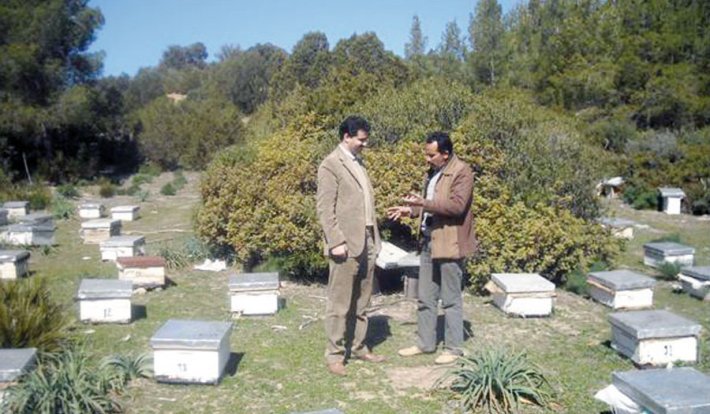
Beekeeping is characterised in Fes-Boulemane by ancestral local know-how and a diversified indigenous melliferous flora (hare's ear, jujube, thyme, rosemary, holm oak and carob) with forests that spread over 260,000 ha and rangelands of 1,000,000 ha. But the sector remains handicapped by a certain number of constraints. Mohammed Mezzour, pastoral agronomist, head of service at the regional directorate of agriculture Fes-Boulemane, put forward during a conference on hive products held recently in Fes, the predominance of the traditional beekeeping sector with some 1,500 traditional hives, the non-valorisation of honey production with a gross margin of 110 DH/kg and the low level of health monitoring. Results: the number of hives amounts to 6,100, including 4,600 modern ones, and honey production does not exceed 62 tonnes. "The traditional hive produces 0.5 to 6 kg of honey while the production of the modern hive oscillates between 5 and 14 kg. In fact, the local selling price varies between 150 and 300 DH/kg," he specifies during his speech. A recent study on local products, piloted by the regional directorate, also reveals that 70% of production is sold in trust networks of beekeepers in poor quality packaging and at lower prices than those practised by resellers within their own networks (158 to 200 DH/kg).
Valorisation of local productsOn the other hand, resellers buy honey from beekeepers, which cost on average 42 DH/kg, at 128 DH/kg to resell it at 200 DH/kg, thus generating a margin of 72 DH/kg. To remedy this situation, develop the conditions of production and valorisation of these products with multiple virtues and support the marketing and promotion of these products (participation in fairs and exhibitions, access to large and medium-sized surfaces), the regional agricultural plan of Fes-Boulemane devotes a series of projects to the beekeeping sector. It involves, among other things, the purchase of beekeeping equipment, the modernisation of the sector through the purchase of modern hives, the upgrading of beekeepers through training and technical assistance. The objective, according to Mohamed Mezzour, is to reach 20 thousand modern hives, improve the production of the hive from 16 to 280t, the organisation of the sector with the constitution of union and economic interest grouping, the valorisation of production with good quality honey and packaging and, ultimately, the improvement of beekeepers' incomes. Better still, there is in prospect the construction of a "honey house" unit and the labelling of the region's honey.
The beekeeping sector in Morocco is characterised by a traditional sector of 250,000 hives managed by 20,000 beekeepers. The average production is 3.5 kg of honey/hive/year while wax production is 300 t/year. In all, annual production amounts to 1,000 t. The modern sector is composed of 120,000 hives and 9,500 beekeepers. The average production is 10 to 25 kg of honey/hive/year which comes from the pollination of natural and cultivated plants. In all, production amounts to 2,500 t to give a total annual production of 3,500 t of honey and 300 t of wax in a normal year. The bee breeds in Morocco are apis mellifica intermissa, apis mellifica heberica and apis mellifica sahariensis.
The objectives included in the framework of the Green Morocco Plan are to increase the number of modern hives from 110,000 today to 610,000 in 2020 and production from 3,500 t to 12,500 t and the creation of some 40,000 jobs.
Provider / Source : Rachida Bami, Le Matin