- Opening hours: Mon. to Fri. 8 a.m. to 6 p.m.

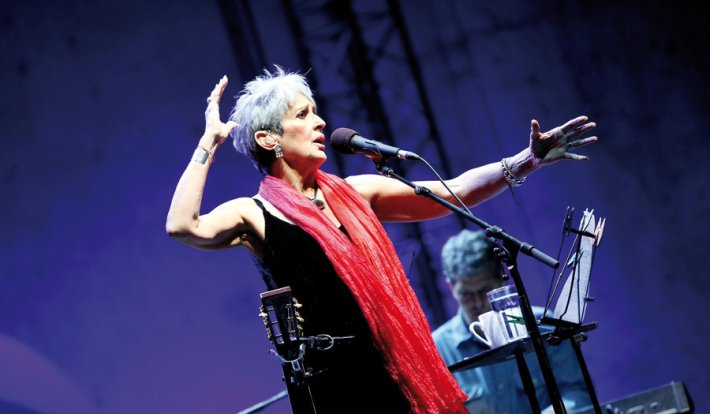
Resplendent, Joan Baez, "Queen of Folk" and mythical figure of the hippie movement, "Peace and Love", hosted the Bab Al Makina stage on Saturday evening with her grace, her deep voice and her guitars, revisited her famous repertoire, covered Dylan and magnificently closed the 18th edition of the Fès Festival of World Sacred Music. Alone with her guitar at the beginning and subsequently accompanied by a percussionist and a multi-instrumentalist who plays everything: guitar, mandolin, banjo, piano, acoustic bass, she led a conquered audience into the 60s and 70s and into folk, this traditional American popular music, which has become over the years a tool for political protest. She sang with great emotion about love, tolerance and peace as she does everywhere she travels. She captivated the audience with her "God is God" by Steve Earle, a song from her latest album (Day After Tomorrow, released in 2008), with the ballad of Mary Magdalene by Richard Shindell, "God on our side" by Bob Dylan and "Gracias a la Vida" and with the great classics like "Here's to you", "Diamond and Rust" which describes her ambiguous relationship with Bob Dylan and "Blowing in the wind". These songs are, moreover, still relevant at a time when folk and acoustic music are returning to the forefront. They demonstrate once again that the commitment of this great singer remains unaltered against injustice and for freedom. Generous, the legend of world protest song even left her place on stage for a few melodies to the young Frenchwoman Marie-Flore who ignited the audience with her strong voice and her talent as a guitarist. Long applauded, the talented Joan Baez even performed in Arabic the famous Tunisian popular song "Jari ya hammouda" by Ahmed Hamza, before finishing her concert with "Imagine", also sung by the audience. During the singing tour which lasted nearly two hours, the fans of Joan Baez and American "folk-song" were simply not disappointed. The concert, in the opinion of the audience, went by too quickly… And this is not strange from the most engaging and most engaged singer of the women of this world. The icon who gave a voice to the protest against the Vietnam War in the 70s and who sang for Sarajevo, for Baghdad and today for Occupy Wall Street as for all the indignant people of the world.
Joan Baez is part of the history of American popular music. She has been carrying the fight for human freedom since the March on Washington for Jobs and Freedom which took place on 28 August 1963. Martin Luther King Jr gave his historic "I have a dream" speech there and Joan Baez sang "We Shall Overcome" there in particular. Her great sensitivity to the suffering of the world pushes her to express herself through music, fascinated at the time by the great black singer Odetta. In Boston, she followed in the musical footsteps of Pete Seeger while the folk movement and the "protest song" were in full swing. Her meeting with Bob Dylan led her towards the ascent and she would be the faithful interpreter of his most historic songs. In 1972, she went to Vietnam in the middle of the bombing of the city of Hanoi and then continued her fight for freedom and against the death penalty throughout the world, including Sarajevo in 1993. An Amnesty International activist, she also created her own association, Humanitas International. In 2008, Joan Baez released "Day After Tomorrow", her 24th studio album, which crowns a rich career punctuated by sumptuous solos and sumptuous duets.
-* The closing evening saw the participation of several personalities from the political, economic and diplomatic world, including the US Ambassador to Morocco and the head of the European Union delegation to Morocco.
-* Folk, from folklore, is a generic term for talking about traditional Anglo-Saxon popular music.
-* Folk is strictly acoustic music played on traditional instruments.
-* Rooted in the American countryside, folk music earned its stripes with artists like Joan Baez and Bob Dylan.
Provider / Source : Rachida Bami, Le Matin