- Opening hours: Mon. to Fri. 8 a.m. to 6 p.m.

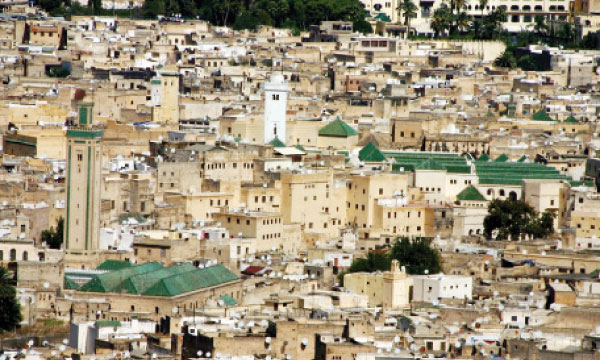
For the third consecutive year, Fès is celebrating its annual day on 4 January. A special date for the city, since it coincides with its foundation by the Idrisids on 4 January 808. This event, which is a first at the national level, is the result of the combined efforts of several civil society entities in the city of Fès, led by the Regional Forum for Environmental Initiatives.
With the objective of perpetuating the glorious history of Fès and its civilisational message that has radiated through time and space, the Fès Day is taking place this year around the theme "Fès and the challenge of upgrading transport and urban mobility". Abdelhay Raiss, president of the Regional Forum for Environmental Initiatives, indicates that: "this theme was chosen by the organising committee because it is a subject of major concern, both for the city's population and for civil society and public authorities". Fès, like other large Moroccan cities, is experiencing perpetual movement and a strong increase in transport demand linked to rapid urban growth. However, the system ensuring the mobility of the population remains behind in relation to increased urbanisation. Consequently, the issue of urban mobility, which is at the heart of the current debate on sustainable urban development, is becoming acute. "To restore a certain urban attractiveness to Fès and optimise the conditions of circulation and movement of its inhabitants, it is essential to have a clear strategic vision. To achieve this, mobility must be placed at the centre of any urban policy, taking into account in particular the future needs of the city in terms of transport means, the enhancement of the urban fabric, infrastructure, and vital spaces of the city, the strengthening of the road network, the development of pavements and kerbs, and the creation of green spaces. In this context, we can follow the model of developed countries, where cities surpass themselves to find innovative urban concepts and creative ideas to improve the mobility and circulation of their inhabitants," explains Mr. Raiss. The other priority points, in relation to urban mobility, which will be addressed during this day are the illegal occupation of the public domain as well as the accessibility of people with disabilities. "Circulation on pavements has become a daily difficulty in Fès and pedestrians suffer enormously to get around. Furthermore, it is particularly difficult, if not impossible, for disabled people to move around normally and access various spaces and infrastructure. Therefore, city planning plans must take into account the specific situation of disabled people and provide all infrastructure and spaces in the city with accessibility," specifies Mr. Raiss. Constituting a meeting space for local associative, economic, and political actors, the Fès Day aims to become an annual commemoration event and to correct various dysfunctions. It is a matter, according to Mr. Raiss, of planning the future of Fès with ideally structured scenarios to arrive at a governance model where socio-economic development leads to sustainable development.
The urban transport sector has been managed for a few months by the private company "City Bus". In recent years, urban transport has been faced with several difficulties (obsolescence of the fleet, deficit in the number of buses, etc.) accentuated by the critical situation of the Autonomous Urban Transport Authority of Fès (RATUF), which was, until then, one of the last authorities in Morocco to manage urban transport. The company started its activities with specifications that provide for the acquisition of buses and the opening of new lines for an investment of 180 million DH from the first year of operation. The contract, which covers a period of 15 renewable years, commits the company to invest some 410 million DH within a period of five years.
-* Fès celebrates its annual day on 4 January. A special date for the city, since it coincides with its foundation by the Idrisids on 4 January 808.
-* The Fès Day is taking place this year around the theme: "Fès and the challenge of upgrading transport and urban mobility".
Provider / Source : Afaf Razouki, Le Matin