- Opening hours: Mon. to Fri. 8 a.m. to 6 p.m.

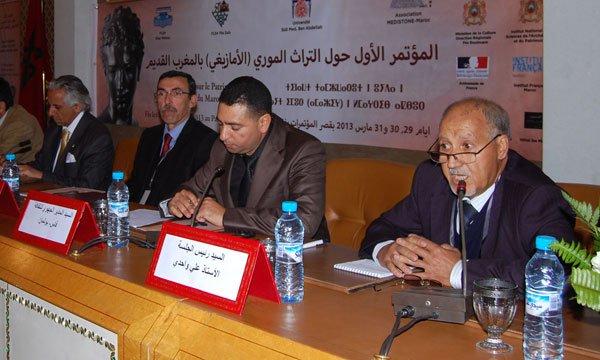
"With a view to a better knowledge of the ancient history of Morocco", such was the theme of the first International Congress on the Amazigh Moorish heritage of Morocco, which was hosted by Fes from 29 to 31 March. Organised by the Sidi Mohammed Ben Abdellah University, the two Faculties of Letters and Human Sciences of Dhar El Mehraz and Saïss, and the "Medistone Maroc" association, in collaboration with the "Friends of Volubilis" association, the National Institute of Archaeological Sciences and Heritage (INSAP), the regional directorate of Culture of Fes-Boulemane, and with the support of the French Embassy in Rabat and the Sefrou section of the Association of Populations of the Mountains of the World (APMM), this scientific event brought together eminent protohistorians, historians, and archaeologists. With the main objectives of promoting the ancient sites of Morocco and making the history of the pre-Roman period known, this colloquium allowed for an assessment of recent research work on the Moorish period and the establishment of research perspectives on the archaeology and Moorish history of Morocco. "This colloquium essentially aims to promote scientific research in the field of Amazigh Moorish heritage and the presentation of the various works carried out in this framework. Indeed, this Moorish period was an essential component in the construction of the Moroccan identity, of which richness, plurality, and social cohesion are the watchwords. This Amazigh Moorish heritage, which results from a accumulation of experiences, skills, and creativity throughout time, therefore constitutes a link between the different generations and components of society. The valorisation of this heritage as well as its integration into the socio-economic development process therefore remain a necessity," explained Brahim Akdim, Dean of the Faculty of Letters and Human Sciences of Saiss in Fes, on this occasion. Within the framework of the work of this scientific event, the conferences and round tables were articulated around three main axes, namely the history and civilisation of Western Mauretania (ancient Morocco), architecture and urbanism, as well as economy and numismatics. This colloquium was also marked by a tribute to Mostafa Ouachi, Mohamed Al Moubaker, and Mohamed Makdoun, former professors of Ancient History and Archaeology at the Faculty of Letters and Human Sciences of Dhar El Mehraz in Fes, for their scientific contribution to research on the various aspects of ancient Moroccan history. It should be noted that on the sidelines of this colloquium, a visit to the two archaeological sites of Banasa (Sidi Ali Bou Jnoun in the vicinity of Mechraâ Bel Ksiri) and Rirha (in the vicinity of Sidi Slimane) was organised on 31 March for the participants of the colloquium.
Since the publication in 1943 of the study by the French historian Jérôme Carcopino "Volubilis, residence of Juba and the Roman governors", archaeological research on the Moorish heritage of Morocco has not ceased to expand in space and time. They have revealed on the surface and in depth the presence of new architectural and stratigraphic data that have increased to a large extent the knowledge on the indigenous substrate of many major sites. The exhaustive census of these various investigations and field work, the analysis of their content, and their dissemination on a large scale have become a priority for the specialists concerned in recent years.
Provider / Source : A.R., Le Matin