- Opening hours: Mon. to Fri. 8 a.m. to 6 p.m.

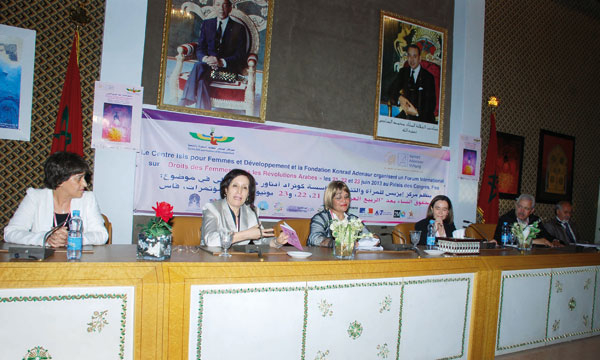
In parallel with the major changes that the Arab world is experiencing today, two years after the outbreak of the "Arab Spring", women's rights are in clear decline. In this context, the ISIS Centre for Women and Development and the German Konrad Adenauer Foundation organised, from 21 to 23 June in Fez, the sixth edition of the International Forum "Mediterranean Women", around the theme: "Women's rights after the Arab revolutions". "We wanted to dedicate the forum this year to this issue which is more relevant than ever, in order to draw attention to the situation of women after the Arab revolutions and the struggles they are waging to impose themselves in their societies. Indeed, women who played an important role in the Arab Spring, manifesting their indignation and anger against all forms of injustice and tyranny, find themselves today victims of physical and psychological violence, discrimination, and social injustice," specifies Fatima Sadiqi, president of the ISIS Centre for Women and Development and director of the Forum. 20 countries were thus represented in this forum, which constituted an opportunity to discuss the new challenges that intellectuals, activists, and politicians must face to promote the situation of women after the Arab revolutions. Nouzha Guessous, professor at the Hassan II University of Casablanca, devoted her intervention during this forum to the oppositions in the name of religion that activists for women's rights in the Muslim world have always faced. "Women's rights have been historically and universally the object of fierce struggles with uncertain and non-definitive results. Gender equality and the fight against discrimination have always clashed with oppositions in the name of religions, cultures, and traditions considered immutable. In this context, women human rights activists in the Muslim world have fought and are still fighting to improve the daily lives of women, but all these demands and struggles for gender equality have been confronted with oppositions in the name of 'the law of God'," she explained. At the end of the work of this meeting, several recommendations were formulated by the participants with the aim of improving the situation of women in the Arab world. These recommendations concern in particular the protection of women's gains in the MENA region, the adoption of a global approach to women's political, civil, social, economic, and cultural rights, the implementation of Constitutions that guarantee gender equality and parity, the involvement of schools and the media in raising awareness and educating women and men, the engagement of civil society in the development and implementation of public policies, as well as the encouragement of dialogue between feminist movements in the Mediterranean region, taking into account the reality in each country.
Created in 2006 by a group of Moroccan teacher-researchers, the Isis Centre for Women and Development is characterised by multidisciplinarity and the use of several languages, notably Arabic, Amazigh, French, and English. This centre has as its main missions the strengthening of studies and research on gender, the promotion of the presence of women in scientific research in Morocco, as well as the promotion of intercultural dialogue inside and outside Morocco. The ISIS Centre also organises national and international colloquia, in addition to study days, workshops, and round tables on gender theories and women's development.
Provider / Source : A.R., Le Matin