- Opening hours: Mon. to Fri. 8 a.m. to 6 p.m.

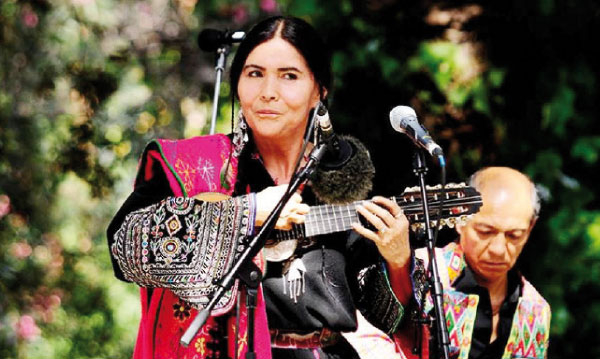
In its approach to exploring the mysteries of the world's cultures and artistic traditions, the Fes Festival of Sacred Music offered the large public present on June 16 at the Batha Museum the opportunity to discover the Uzbek and Kazakh songs and poetry of the female trio Bardic Divas. Composed of Raushan Urazbayeva and Ulzhan Baibussynova (Kazakhstan), as well as Nodira Pirmatova (Uzbekistan), Bardic Divas embodies today the excellence of a poetry and culture influenced by the Silk Road, precious stones, ancient palaces, and the nomadic steppes of Central Asia. Heroic poetry is the common jewel of nomadic herders, from the Caspian Sea to the Sea of Japan, which these three women appropriate, giving it a touch of feminine softness and nomadic nobility. Artists at heart, they treated the audience to a magical performance where poetry and music coexist, complement, and sublimate each other. They thus interpreted the Kazakh epic song "jyraou", which is often compared to a thoroughbred that gallops, sweats, and arouses the admiration of all. "Just before interpreting it, we have tea with lamb meat, because the 'jyraou' who sweats sings better," explains Ulzhan Baibussynova. From their rich repertoire, they also presented the "kuï", short pieces like musical images of a being, a philosophical reflection, or an emotional state. Raushan Urazbayeva, who perfectly masters this register, became one with her traditional musical instrument "qyl-qobyz", embracing every inflection of the bow, playing by "feeling", and varying the figures, rhythms, and climates with eloquent subtlety. The Fes public also had the opportunity to discover, thanks to the female trio Bardic Divas, the refined art of the "Shash-maqâm" courts, scholarly music that managed to abolish the border between Uzbekistan and Tajikistan, mixing voices and instruments. In the 16th century, the "Shash maqâm" was a highly refined court art, renowned in Bukhara, but also in other major cities located on the Silk Road, including Khiva, Tashkent, Samarkand, and Kokand... In these historically multicultural cities, the "Shash maqâm" seized texts of Sufi inspiration and adorned itself with orchestral suites to fulfill all social functions, from the sacred to the profane, from prayer to dance. Before Bardic Divas, the audience of the Fes Festival of World Sacred Music had the opportunity to discover the Bolivian Luzmila Carpio, who performed on Sunday, June 15, at the Batha Museum. Always having been conscious of her Quechua-Aymara Amerindian roots and the difficulty of reviving the riches of a civilization once decimated by the Spanish conquistadors, Carpio is recognized today as the ambassador of Bolivian indigenous culture. Singing in Spanish and Quechua (Amerindian language), she opened the doors of a poetic, almost forgotten musical universe to the spectators of the Fes Festival. A cappella or soberly accompanied by a charango, a guitar, flutes, or choleurs, Luzmila sang prayers dedicated to the deities, her people, and nature with a voice that seems to reach the mountain peaks and cross the high plateaus of the Andes like the flight of a bird. The Nights of the Medina, spread over three evenings, the Nights of the Medina offered for several years by the Fes Festival constitute a true musical and initiatory journey in the heart of traditional houses and Riads.
The Nights of the Medina, which take place this year from June 16 to 18, offer the public the opportunity to travel to the four corners of the world with artistic performances that are diversified, rich, and colorful.
The menu of the 2014 Nights of the Medina thus includes concerts hosted by Wang Li (China), Majlis Trio (France), Ensemble Atlan (Ireland), Mor Karbasi (Spain), Zakir Hussain (India), the Saint-Ephraïm Choir (Hungary), Tomatito Sextet (Spain), Leili Anvar (Iran), as well as Khalil Abu Nicola (Palestine).
Provider / Source : Le Matin