- Opening hours: Mon. to Fri. 8 a.m. to 6 p.m.

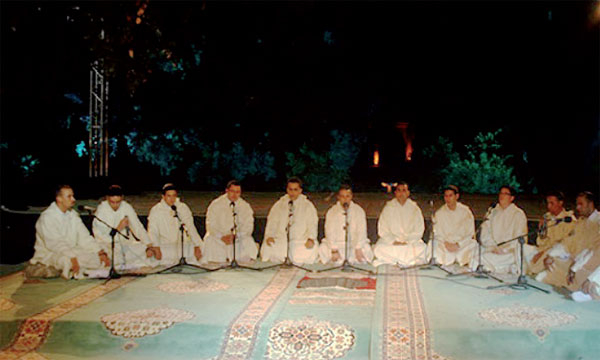
The Sufi Culture Festival continues in Fez, continuing to unveil the many secrets of spiritual fulfilment. It is a true therapy for the soul that the public, present in large numbers on 13 April at the Batha Museum, was treated to in order to attend the "samaâ" evening of the Bouchichiyya and Siqilliya tariqas. Divine invocation, "dikr", mystical poetry and prayers sung a cappella, all the ingredients were there for a most majestic result. Communicating subtle meanings and a spiritual aspiration that orient the spirits towards the divine source, the members of these two brotherhoods aroused in the audience an ecstatic emotion and an incomparable spiritual intoxication. After this magical evening, the festival audience resumed, on 14 April, its initiatory path, in the footsteps of Ibn Arabi, as part of a round table dedicated to the biography of this great Muslim thinker. Speaking on this occasion, Mohamed Adlouni, researcher and writer, reconstructed the journey of Ibn Arabi, punctuated by encounters, discoveries and adventures that led him to unity and the experience of divine proximity.
"Born in Murcia in Spain, Ibn Arabi grew up in an environment distinguished by material ease and the love of knowledge, and where an atmosphere of piety reigned. Reaching adulthood, he received the call of God and decided to devote himself to the deepening of metaphysical and traditional studies and to visiting the great spiritual masters in different places of the land of Islam, to benefit from their experience. In this context, his meeting with Averroes (Ibn Rushd) in Cordoba, and his travels in the Maghreb and the Middle East had a determining impact on his thought and his work," he explained. And to add that "the existence of Ibn Arabi, from his entry into the Spiritual Path and until the end of his life around the age of eighty in Damascus, was only a search for perfection and a continuous evolution towards truth and peace".
For her part, Hayat Kara, university professor, focused on Ibn Arabi's stay in Seville, the city where he developed his love of knowledge by acquiring the foundations of classical Muslim culture, both literary and religious. She also highlighted one of the main components of his thought. "According to Ibn Arabi, the famous saying of the Prophet Mohammad 'Who knows himself, knows his Lord' ('Man 'arafa nafsuhu faqad 'arafa rabbah'), takes on its full meaning. For him, in order to reach full spirituality, it is imperative to know oneself, the knowledge of one's Lord being the fruit of the knowledge of one's inner self. This thesis is notably defended in his work 'Fuçuç al-Hikam', whose title in French is The Wisdom of the Prophets," she stressed. The exploration of the mysteries of Ibn Arabi continued during the day of 14 April with the screening of the feature film by Tunisian filmmaker Nacer Khemir, "Looking For Muhyyedin". This film of more than 3 hours takes the form of a tale and a true adventure. It tells the story of a man who returns to his country to bury his mother and who then makes a promise to his father to set off in the footsteps of Sheikh Moheiddine (Ibn Arabi) to discover his teaching and his thought.
A journey that takes him to 9 countries of the world to meet confirmed thinkers and convinced followers, who venerate Ibn Arabi and adopt his doctrine. A masterful work Moheiddine Ibn Arabi was born on 28 July 1165, in Murcia, Spain. He died on 16 November 1240, in Damascus, Syria. Theologian, jurist, poet, metaphysician and Arab-Andalusian master of Sufism, Ibn Arabi is considered the most complete and profound author of the spiritual tradition of Sufism, with a bibliography rich in more than 400 works, some of which count several volumes such as "Al Futuhat al Makkiya" ("The Meccan Illuminations" in 37 volumes) or the explanation of the Quran (now lost, in 64 volumes). The influence of Ibn Arabi in the history of Islamic spirituality is immense, extending to numerous Sufi brotherhoods such as the Chadhiliyya, the Khalwatiyya, or even the Mawlawiya.
Provider / Source : Le Matin