- Opening hours: Mon. to Fri. 8 a.m. to 6 p.m.

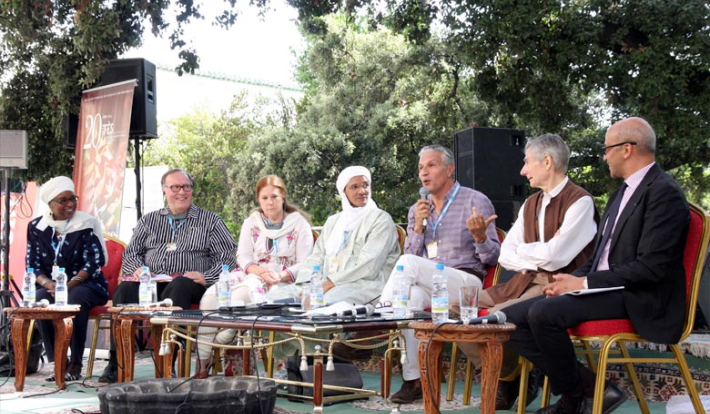
A host of Moroccan and foreign intellectuals, historians, and academics debated Sunday, within the framework of the Fes Forum "a soul for globalisation", the relationships of art in Africa to the sacred.
During this meeting focused on the theme "Africa and the sacred", the participants emphasised the various forms of religious and spiritual traditions in Africa, stressing that such secular traditions constituted the foundation of communities.
They also highlighted the creation in Rabat of the Al Mowafaqa Ecumenical Institute dedicated to university training in theology in French open to ecumenism and cultural and Islamic dialogue, stressing that this institute perfectly illustrates that Morocco is a country of openness and intercultural and inter-religious dialogue.
Speaking on this occasion, the French researcher and historian, Marguerite Sabran, indicated that traditional art objects from sub-Saharan Africa had in their original context a fundamental relationship to the sacred, adding that currently these art objects are gathered in private or museum collections in Europe, the United States, or Africa.
Ms. Sabran advocated in this context a new way of approaching these heritage objects to re-establish a fairer look at Africa through the highlighting of the artistic characteristics of the works and their creativity.
For his part, Samba Papa Diop, professor of Francophone literature at the University of Paris Est Créteil (France), discussed the relationships of the former Senegalese president Léopold Sédar Senghor with art in general and particularly painting and dance, recalling that Mr. Senghor had the intention of creating a city of arts on the Dakar corniche.
The director of the Al Mowafaqa Ecumenical Institute of Theology, Bernard Coyault, for his part, evoked the social habits, rituals, religious multiplicity, and informal economy that characterise certain villages in sub-Saharan African countries.
For her part, the Moroccan intellectual, Meryem Sebti, discussed the sacred dimension of art through the presentation of thoughts of many Moroccan and foreign artists who believed that the collection of art objects could give them a new meaning such as masks and paintings.
The Forum of the festival "a soul for globalisation", initiated within the framework of the Fes Festival of World Sacred Music, brings together intellectuals, diplomats, politicians, and artists.
It focuses, this year, on themes related to Africa, including "linguistic pluralism in Africa", "major contemporary issues", and "Hassan Al Wazzan" (Leo Africanus), "spiritual paths and commercial paths", in addition to "Africa and the sacred".
Provider / Source : MAP, Le Matin