- Opening hours: Mon. to Fri. 8 a.m. to 6 p.m.

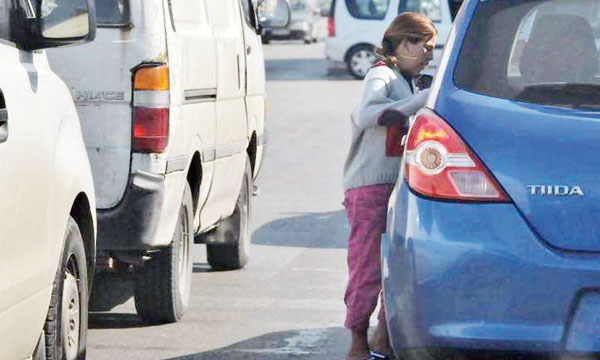
Passing through Mohammed V Avenue in Fez is today an obstacle course. Alongside street vendors and "Ferracha" (informal traders), child beggars, alone or with their parents, are the main occupants of the pavements and public roads. Using all means of persuasion to obtain the favour of charitable souls, they cling to the clothes of passers-by, even blocking their path to achieve their ends. This situation is the same almost everywhere in the city. An alarming observation that constitutes a source of concern for the city's inhabitants. "Unfortunately, we have to face scenes that break our hearts without respite. In addition to infants lying on the ground and exposed to the sun and microbes, in the company of heartless women, many children spend their days on the street begging when they should be at school or at home, sheltered from the dangers that await them," says Saïda, a bank employee, exasperated. For her, this phenomenon, which continues to grow in Fez, represents an attack on human dignity. It also poses a security problem by encouraging the harassment and assault of citizens and damages the image of the city by trivialising the occupation of public space. Officials from the regional coordination of National Mutual Aid state that there is an absence of exact figures for child beggars in Fez. Only data collected following field trips by the teams of the Bab Khoukha Multidisciplinary Social Complex in Fez exist. In 2013, 77 children engaged in begging activities were taken in by members of the Mobile Units of the Complex's Anti-Begging Cell. "This work carried out by our teams with the help of local authorities, within the framework of a partnership with the Ministry of Solidarity, Women, Family and Social Development and the INDH, allows us to distinguish two categories of child beggars. These are children exploited by their families and those who live on the street. The first category includes, in addition to infants and young children used by mothers to elicit pity from passers-by, children pushed to beg to meet their families' needs.
The second category concerns children abandoned on the street from a very young age, as well as children who are victims of the breakdown of the family unit, leaving school before ending up on the street and engaging in all kinds of delinquency. The latter are drug addicts, live in communities, and prefer to beg in groups," explains Abdellatif Daoui, director of the Bab Khoukha Multidisciplinary Social Complex in Fez. He adds, "these children that we take in following our field work are received at the complex, listened to by our social workers, and sensitised with the objective of dissuading them from returning to begging. We then proceed to their identification, before establishing a file and conducting a social investigation to determine the method of treatment for the different cases." After this stage, some of these beneficiaries are reintegrated into their families, while others are taken care of by the complex or by other social protection establishments such as the "Awladi Centre" for the information and integration of children and young people and the "Ahli Centre." However, the director of the Bab El Khoukha Multidisciplinary Social Complex laments that these efforts often run up against the lack of adherence of the targeted categories, who refuse socioeconomic insertion and end up returning to their "business," which they deem very lucrative. "Begging turns out to be the easiest solution for many layers of society that suffer from precariousness, believing that there is no other activity that could allow them such an easy gain while bringing in so much," indicates Mr. Daoui.
Consequently, this intolerable situation is not about to disappear. And the worst part is that to the Moroccan child beggars, sub-Saharan and Syrian children have recently joined, who, along with their families, also count on the compassion and generosity of the people of Fez to survive.
The law criminalises begging: The Moroccan Penal Code considers begging as an offence against public security. Article 326 imposes a sentence ranging from 1 to 6 months in prison on any person practising begging. Regarding Article 327 of the Penal Code, it imposes a sentence ranging from 3 months to 1 year in prison on "all beggars, even if disabled or devoid of resources, who solicit charity. Article 328 mentions the same penalty against "those who, either openly or under the guise of a profession, employ children under the age of thirteen for begging."
Provider / Source : Le Matin