- Opening hours: Mon. to Fri. 8 a.m. to 6 p.m.

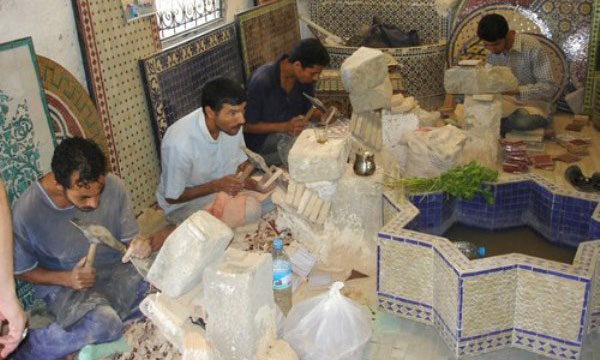
Endowed with ancestral know-how, Fez pottery, of very ancient origin, stands out for its finesse and the dominance of cobalt blue, the city's colour, and patterns that combine green and golden yellow. As for the art of zellige, it is also one of the most characteristic and emblematic traditional sectors of Fez, whose main asset is the expertise of the Moors of Andalusia who settled in the city.
To give a boost to these traditional trades, which show similarities in terms of manufacturing and firing, several initiatives have been launched in recent years in the city of Fez. This includes the project to create the Benjellik artisanal village, which was initiated in 2004 with the aim of grouping all the potter-zellige makers of the city on a 27-hectare plot of land. The objective was to put an end to polluting activities that constitute a real danger to the life of the local population, to improve the working conditions of the artisans, as well as the quality of their production, and to increase their income. Of the 197 pottery and zellige units that the village has, 131 are operational to date, each employing between 5 and 10 artisans. Despite the transfer of the majority of the potter-zellige makers of Fez to the Benjellik district, the path to the success of the project is strewn with pitfalls, as affirmed by Naji Fekharri, president of the Chamber of Crafts of Fez-Boulemane. “The Benjellik artisanal village suffers from several dysfunctions, particularly in terms of equipment, roads, or even the access of artisans to their production units. Indeed, besides the absence of collective transport for the artisans, the road that leads to the Benjellik district is in a very degraded state,” he explains. Furthermore, the artisans installed in Benjellik still use traditional kilns in the manufacturing process of their products, given that the operation of modernising production tools by introducing gas kilns into the manufacturing process has not succeeded. Falling within the framework of the “Support for Production” of the “Crafts and Medina of Fez” project, financed by the Millennium Challenge Corporation (MCC), this initiative provided for the generalisation of the use of gas kilns, by accompanying the artisans in their process of replacing traditional kilns reputed to be “polluting”, through financing up to 80% (40% from the MCC and 40% from the National Fund for the Protection of the Environment - FNE). Despite their positive contribution in terms of environmental preservation, the gas kilns proposed to the artisans in the framework of this action did not meet with success, because they could not win the support of the artisans. The latter were, indeed, critical of their firing quality, particularly for zellige, in comparison with traditional kilns,” he specifies. To remedy this situation, the president of the Chamber of Crafts of Fez-Boulemane indicates that a new project concerning the introduction of modern kilns using gas as fuel, in the pottery and zellige activities in the city of Fez, is in the study phase. The result of a partnership between the Ministry of Crafts, the Ministry of the Environment, and the Council of the Fez-Boulemane region, this project should allow potter-zellige artisans to acquire gas kilns that would meet their expectations and requirements in terms of firing quality and colour. Other constraints for the sector: The upgrading of pottery and zellige activities in the city of Fez comes up against several other constraints, notably the scarcity of quality raw material and the incompatibility of the work environment with health and safety standards. “In 2010, the quarry that we used to exploit, and which falls under the Ministry of Habous and Islamic Affairs, was closed following an incident. This quarry provided us with clay of excellent quality, unlike the one we use today. Furthermore, potter-zellige artisans are in direct contact every day with toxic chemical substances, notably lead, which represents a real threat to their health. In this sense, we are currently trying to find alternative solutions to the use of lead to reduce the risks to the health of potter-zellige makers.
Provider / Source : Le Matin