- Opening hours: Mon. to Fri. 8 a.m. to 6 p.m.

Every day, the Autonomous Intercommunal Water and Electricity Distribution Authority of Fès (Radeef) distributes nearly 194,000 m3 of drinking water on average to satisfy the needs of more than 1 million inhabitants of the city of Fès and its region. It ensures that it monitors the quality of the liquid by carrying out a battery of checks at catchment points, in production, and during distribution.
Water being an essential material, but very fragile and dangerous when its quality is altered, explains Ghizlane Fares, head of the quality division at the South hydraulic complex, to journalists and a representative of civil society during a visit to the South hydraulic complex, organised on 24 March on the occasion of World Water Day. "Its surveillance, protection, and treatment are an absolute necessity.
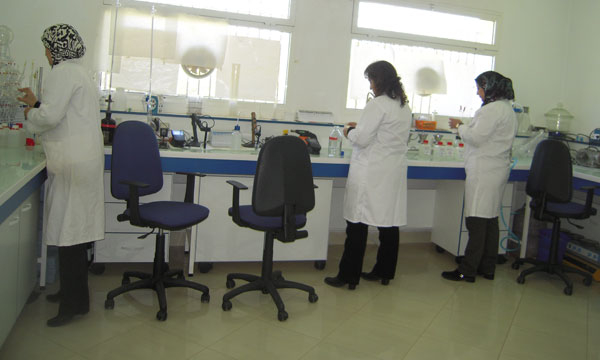
Within the laboratory, the managers and technicians watch over the quality of the water delivered by the Radeef to the inhabitants of the cities of Fès, Sefrou, Bhalil, as well as the rural communes of Bir Tam-Tam, Ras Tabouda, Sidi Hrazem, Aïn Timgnal, Oulad Taïb, Douar Aït Taleb, and Douar Aïn Alquadi to offer safe and reliable water," she adds. Nadia Othmani, director of the laboratory, specifies for her part that her staff covers nearly 126 control points daily, scrutinising the networks from the source to the consumer's tap to identify potential dangers and eliminate them. "The checks concern microbiological, industrial, and chemical contaminants, and also aim at the physical characteristics of the water, such as taste and odour. They are accompanied by the taking of water samples from the entire distribution system for analysis," she adds. Questioned about the taste and odour of tap water, which differ in certain neighbourhoods of Fès, notably the Medina, Bendebab, Jnanate, and Bensouda, and which worry the inhabitants, Nadia Othmani explains that the water network can be supplied by a watercourse, a groundwater table, or a spring and that the taste differs according to the origin. This water undergoes several treatments, among others, screening and sieving, clarification, filtration, as well as disinfection, often with chlorine, which eliminates all micro-organisms dangerous to health.
It is declared potable if it meets a series of criteria such as organoleptic parameters (colour, odour, flavour...), physico-chemical parameters (temperature, pH, chlorides, sulphates), microbiological parameters, and micropollutant parameters. A slight residue of chlorine is also maintained during the water's journey in the distribution network to the tap to avoid bacterial proliferation. "The drinking water distributed in the city of Fès and its region complies with national and international quality standards. Nearly 30% of this water is captured and treated by the Radeef, while 70% is captured from Oued Sebou and treated by the National Office of Electricity and Drinking Water.
The checks are carried out by the Radeef's internal laboratory, the (ONEE) laboratory, approved external control and audit offices, and municipal hygiene services, in addition to the Ministry of Health," she stresses. The laboratory also ensures the control of cleaning and disinfection operations of new pipes, the carrying out of water quality surveys following subscriber complaints, and the washing and disinfection of reservoirs and water points. And there is good reason. If there is pollution in the drinking water and the analysis is not done in time, it can cause serious public health problems. 86 million dirhams for drinking water in Fès in 2014: The 2014 action plan of the Radeef allocates 86 million dirhams for the drinking water sector in Fès and its region, out of a total envelope of 229 million dirhams dedicated to investments projected in 2014 for the electricity, drinking water, and liquid sanitation sectors.
These investments are in addition to those made in 2013, concerning in particular the renewal of water networks, the rehabilitation works of the Moulay Abdellah collector, as well as the water and sanitation equipment of the Berkani neighbourhood within the framework of the INDH.
Provider / Source : Le Matin